KEYSTONNE AI THE MANAGER THAT NEVER LEAVES THE BUILDING
KAI. All the intelligence. None of the fiction.
Not a promise about how carefully we prompt it. A rule in the runtime: every figure KAI puts in front of you is computed by the engines and checked against them before you see it. Anything else is discarded rather than shown.
Most AI products ask you to trust the output. This one is built so you do not have to — every stage below exists to make the answer checkable rather than convincing.
01
YOU ASK
A question in your own words.
English or Hindi, typed or spoken. No query builder, no report to configure first.
02
IT READS
Your rows. Only ever yours.
The model calls read-only tools that run inside your restaurant’s own scope. It cannot reach another business’s data, because the isolation is enforced in the database rather than in the prompt.
03
ENGINES COMPUTE
The maths is not the model’s job.
Every figure is produced by deterministic code — the same code that renders your reports. The model receives finished, provenance-tagged facts.
04
THE GATE
Every figure is checked before you see it.
A validator scans the model’s sentence for digits and rejects the whole answer if any of them is not an exact match of a verified fact.
05
YOU SEE
An answer you can open up.
Each figure carries the rows it came from. Disagreeing with it is a supported move — that is what the provenance is for.
06
IT PROPOSES
A draft, waiting for you.
When there is something to do, it drafts it. The draft sits in an approval inbox and changes nothing until a person with the authority approves it.
02 / THE THREE LAWS
Rules it cannot talk its way around.
Everyone says they are careful with AI. These are stated with the mechanism that enforces them, because a mechanism is something you can check and a promise is not.
01
KAI never computes your money.
Deterministic engines compute every rupee; the model writes the sentence around figures it has been handed. A validator then re-checks the sentence and rejects it if a digit does not match a verified fact — in Latin or Devanagari numerals, because the product invites questions in Hindi.
A rejected answer is not corrected and shown. It is discarded.
02
KAI proposes. It never writes.
The registry of tools the model may call to change something contains exactly one entry, and all it can do is append to an approval inbox. Domain writes are not in the AI layer at all — not disabled, not gated. Absent.
On approval, the proposal runs the same action a person would.
03
When it cannot help, it says so.
Every KAI surface has a defined ladder for the moments it cannot run — no key configured, not on your plan, allowance spent, rate limited — and each rung shows a plain explanation and the deterministic view instead.
The surface degrades. It does not disappear and it does not lie.
03 / THE GATE, RUNNING
Watch a wrong number fail to reach you.
The rule below is the product’s own, applied to a fixed example in your browser. Pick a candidate answer and see which figures survive.
VERIFIED FACTS
Computed by the engines. These, and nothing else, are the figures the sentence below is allowed to contain.
Reporting window
30 days
Units sold in the window
318
Margin per unit
₹142
Supplier price change
₹18
CANDIDATE ANSWER
Paneer Tikka sold 318 units in the last 30 days at a margin of ₹142, after the supplier price rose ₹18.
Passed — shown to you
Every figure matches a verified fact exactly, so the sentence is shown.
The check above runs in your browser. It is the product’s rule applied to a fixed example — not a conversation with KAI, and not a recording of one.
04 / WHAT IT IS MADE OF
31read-only tools
Sales, leakage, payout reconciliation, stock variance, menu profit, prep, channel realisation, cohorts, dayparts, team, receivables, expenses, books, GST, loyalty, HQ, reviews, forecasts, weather, market prices, festivals and returns. Every one of them reads; none of them writes.
8tools that may propose
The complete set of things KAI can do that leave a trace — and all any of them does is add a draft to an approval inbox. There is no ninth tool that writes to your business.
0figures it may invent
Narrated figures must reference a fact the engines computed and tagged. An answer whose numbers do not resolve is rejected whole and replaced with the deterministic one.
“AI-powered” is unfalsifiable. These are countable — which is the point of publishing them.
05 / WHERE KAI SHOWS UP
Not a chat box bolted onto a POS.
01
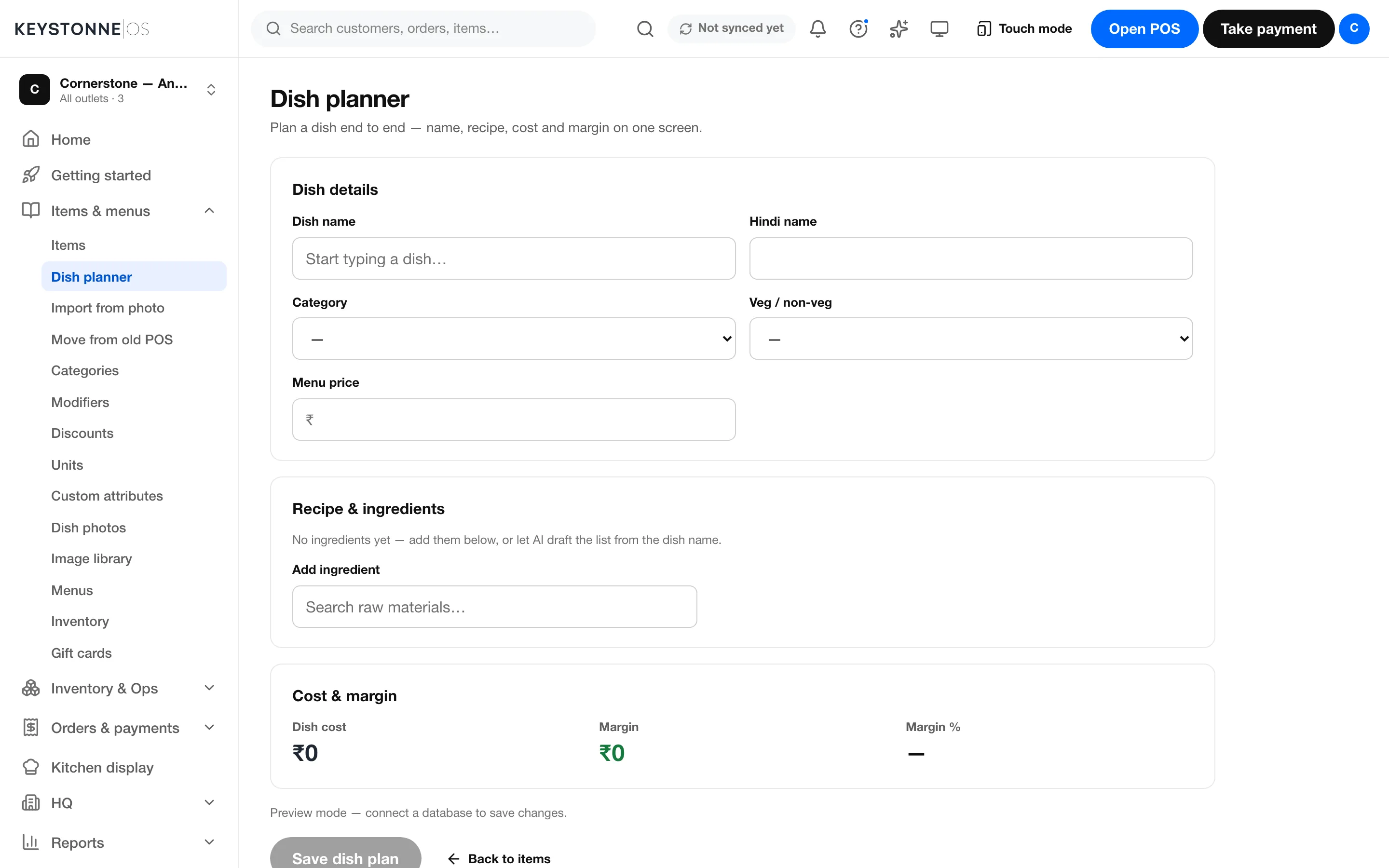
DISH PLANNER
Build a dish. Keep the costing honest.
Describe a dish and KAI drafts its name, its ingredient list, quantities and units — then hands it to you to correct. Anything the parser cannot read confidently is flagged for review rather than quietly tidied away.
WHAT IT DOES
Drafts a dish’s name, ingredients, quantities and units.
WHAT IT REFUSES
Never prices it. Costs come only from your own item costs.
02
AI PROJECTIONS
What tomorrow probably looks like.
Revenue, covers, prep quantities and stockout risk, projected per item and then summed. KAI is what makes a projection usable: it reads the numbers, tells you which moved and why, flags the day worth looking at, and drafts the order that follows.
WHAT IT DOES
Reads the projection, explains what moved, drafts what follows.
WHAT IT REFUSES
Never does the arithmetic. Engines compute it in exact paise.
PROJECTED REVENUE=expected demand × your current price
70%Same weekday
Saturdays are compared with Saturdays, which is what catches a weekend that behaves differently from a Tuesday.
30%Overall trend
A stabiliser, so one thin weekday sample cannot swing the whole projection.
×Festival multiplier
Applied from the regional calendar your outlet’s pincode resolves to — a festival in your state, not a national average.
No model computes this. The engines do, in exact paise, and KAI explains the result.
A 28-day windowLong enough to see a pattern, short enough to notice that the pattern changed.
Backtested against doing nothingThe blend is scored against a naive baseline. If it cannot beat “same as last time”, that is worth knowing.
Bands only when earnedA confidence range is shown only where there is enough history to justify one. Thin evidence gets no band rather than a decorative one.
Your overrides winA closure, a promotion or a day you know will be different is an input, not an argument with the model.
03
LIVE INGREDIENT PRICE
Six answers to “what does this cost?”
An ingredient’s price can come from six places and they are not equally worth believing. Keystonne ranks them and always uses the strongest one it has — which puts KAI’s own estimate at the bottom, below five kinds of real evidence.
WHAT IT DOES
Ranks six sources and always uses the strongest available.
WHAT IT REFUSES
Never lets its own guess outrank evidence, or be recorded unlabelled.
Strongest
You told us
A price you entered yourself. Nothing outranks the person who buys the thing.
Keystonne always uses the strongest rung it has. KAI’s estimate is the last resort, and it is labelled a guess everywhere it is shown — including in the cost it would otherwise silently become.
04
PINCODE MENU PRICE RESEARCH
What this dish goes for in your area.
Your outlet’s pincode resolves the locality it actually trades in, and that locality goes to KAI along with the dish, its category and what your own menu already charges for things like it. What comes back is a suggested price and one short line of reasoning you can judge.
WHAT IT DOES
Suggests a price for your locality, anchored to your own median.
WHAT IT REFUSES
Never applies it, and never puts a number in its own reasoning.
₹120your Starters median · ₹240₹720
Admissible range: half to three times your own median for this category.
Suggested ₹320 — shown as a draft
Inside the fence. Shown, labelled as a model suggestion, waiting for Apply.
It is a draft, alwaysThe figure lands in the price box only when you tap Apply, and saves through exactly the path a typed price takes. Nothing writes on its own.
Fenced to your own menuA suggestion is clamped to between half and three times your own median for that category. A model that hallucinates ₹9,000 for a chai cannot get that number onto your screen.
05
LOCAL CONTEXT
Your pincode is not just an address.
The same locality does more than price a dish. It selects the regional festival calendar that moves your projections and the market references your ingredient prices fall back to — a festival in your state, not a national average.
WHAT IT DOES
Selects the festival calendar and market references that are yours.
WHAT IT REFUSES
Never treats a public wholesale reference as what you actually paid.
410 001MAHARASHTRAREGIONAL CALENDARYOUR FORECAST
06 / WHEN IT CANNOT HELP
The four ways it stops, all of them out loud.
ASK AND UNDERSTAND
On every plan
Copilot
Ask about sales, menu, stock, customers and outlets in plain language.
Why did this happen
Take a number that moved and get the contributing factors, with the rows.
Day replay
Walk back through a service to find where it went differently.
Menu profitability
See which dishes earn their place, by margin rather than by popularity.
DO THE WORK FASTER
On every plan
Voice entry
Speak an order or an expense instead of typing it.
Dish planner
Build a dish with its recipe, costing and menu placement in one pass.
Import mapping
Point at a spreadsheet and have its columns understood.
GST help
Ask about your own tax position rather than reading a circular.
THE AGENT AND THE EYE
Advanced and above
Action proposals
Drafted price changes, purchase orders and item updates, waiting for approval.
Daily brief
What deserves attention today, prepared before you ask.
Photo capture
An invoice, a menu or a shelf becomes structured data from a photograph.
Review replies
Drafted responses to guest reviews, in your voice, for you to send.
FACING YOUR GUESTS
Advanced and above
Storefront assistant
Answers guests’ questions about your menu, from your own catalogue.
Group intelligence
Ask a question across every outlet at once.
Local context
Bring outside signals — weather, market prices — alongside your own numbers.
Every surface here ships today. Capabilities in development are not listed, and a plan entitlement is not the same as a feature being available for your setup — check the workflow you need before choosing a plan.
07 / WHEN IT CANNOT HELP
The four ways it stops, all of them out loud.
An AI feature that fails quietly is worse than one that is absent: you go on trusting a surface that has stopped telling you anything. KAI has four defined ways to be unavailable, each of which says which one it is and shows the computed view instead.
01
Not configured
No AI key on this deployment. The surface says so and shows the deterministic view.
02
Not on your plan
The capability is named, with what it would take to reach it. Nothing is hidden.
03
Allowance spent
Your monthly tokens ran out. Every surface falls back to computed answers until it resets.
04
Too many requests
A short, stated pause. It comes back on its own.
The deterministic view is always there underneath. KAI is what sits on top of it, not what replaces it.
08 / WHAT IT COSTS
KAI is on every plan.
Including the free one. What the paid tiers add is the agent — the drafts, the daily brief, the photo capture and the guest-facing surfaces — not permission to ask a question.